Things I’m figuring out.
I’m Siddharth. I build tools for people and AI to think and work together—and explore the systems that make that possible.
Right now, most of that curiosity goes into Accord  .
Project index
07 projects & experiments01 Accord
Human–AI workspaceBounded alpha

Accord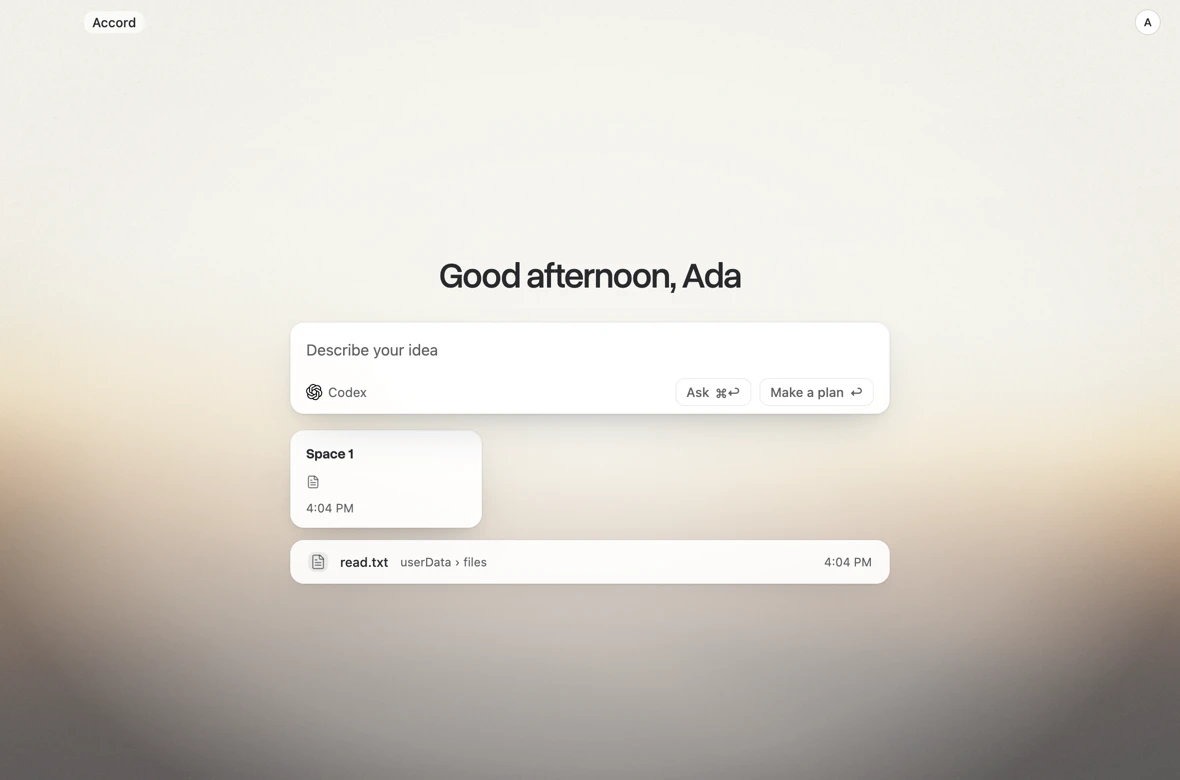 (opens in a new tab)
My main project: a shared workspace where people and AI can think, explore and make things together.
Behind the project
- Why I’m building it
- I want AI to work alongside me on the same material, while I keep working too. That means making changes understandable and letting me keep the parts I actually want.
- What’s there
- An Electron alpha with local notes, captured files, scoped sharing, explanations and reviewed passage changes. The current qualification is deliberately narrow.
- The question I’m testing
- Can a shared workspace make the person and the AI more capable together, with less effort spent coordinating them?
02 Loom
Agent evaluationResearch prototype
LoomAn agent failed. Was it the model, the tools, the context—or the way I put them together?
Behind the project
- Why I’m building it
- Giving an agent more tools is easy. Figuring out why it failed is harder. Loom starts with the configuration and execution evidence, then asks what is worth changing.
- What’s there
- An early local diagnostics prototype that links findings to evidence and produces candidate harness specifications and experiment plans.
- What I’m still learning
- A passing simulation does not settle reliability. Failed experiments stay in the record, and suggestions are not automatically deployed.
03 Infera
Open-model inferenceEngineering project
InferaThe work between a model on a GPU and a service someone can actually use.
Behind the project
- Why I’m building it
- I wanted to understand the whole serving system: provisioning a GPU, starting a worker, routing a request and knowing what it costs.
- What’s there
- A Go gateway, Python inference workers and a React dashboard for instances and costs. The project explores an OpenAI-compatible interface for open models.
- What needs measuring
- Readiness, first-token latency, throughput and cost belong in the same conversation. Local implementation alone does not establish production performance.
(opens in a new tab)04 WorldLens
World-model experimentsSDK prototype
WorldLensAn observe → predict → plan loop for exploring how agents could reason about a changing world.
Behind the project
- The question
- How could an agent compare possible actions against a model of what happens next?
- What’s there
- A Python SDK prototype with structured world states, a mock backend, provider interfaces, frame-sampling plumbing and a simple planner.
- Where it stands
- The interfaces are ahead of the learned world models. Real JEPA-style backends are not integrated, and prediction quality has not been established.
05 HomeStock AI
Everyday coordinationMVP / mock commerce
HomeStock AIA shared grocery memory for a home. “Dahi le aana” should make it onto the same list as everything else.
Behind the project
- The question
- Can everyday requests from family, flatmates and a cook become one clear list, with someone responsible for deciding what gets bought?
- What’s there
- A Next.js MVP with Hindi/Hinglish grocery normalization, household roles, request approval, recurring-item suggestions and mock cart preparation.
- Where it stands
- Commerce is simulated. Real ordering, payments and a live Swiggy connection are not enabled.
(opens in a new tab)06 StoryBeats
Photos × musicWeb experiment
StoryBeatsA lighter experiment: finding music that feels like a photo, across Hindi and English songs.
Behind the project
- The question
- A photograph has a mood. Could that be a useful starting point for discovering a song?
- The approach
- The repository explores image analysis, mood categories and Spotify-based recommendations, with a mix of Indian and English-language music.
- Where it stands
- This is an experiment, not a promise that every recommendation will land. Provider availability and the complete hosted flow have not been qualified here.
(opens in a new tab)07 Boundary Lab
Agent isolation experimentsLearning lab
Boundary LabA place to take things apart and learn what an agent should—and should not—be able to reach.
Behind the project
- The question
- Where should an agent’s work run, and what should it be allowed to reach?
- The exploration
- A first-principles learning space for isolation, permissions and the separation between a controller and its execution environment.
- Where it stands
- An ongoing learning project, rather than a qualified sandbox or a production security product.
Notebook / Thinking out loud
What makes an agent dependable?
I’m increasingly interested in what happened between the prompt and the result. Did the agent use the right evidence? Did it know when to stop? Could I explain why it took that action?
That is the question behind Loom. I want a useful diagnosis to point to something I can inspect and test. A convincing explanation is only a starting point.
A working note from Loom.
The model is only part of the system.
Starting a model on a GPU feels like the hard part—until the next request arrives before the worker is ready.
Infera keeps pulling me toward the surrounding system: who decides a worker is ready, where requests go, what happens when that evidence goes stale, and what the whole thing costs. Those boundaries are becoming as interesting to me as the model itself.
A working note from Infera.
A little about me
I tend to start with “could this work?” and then keep going until I can take the thing apart and understand it.
That has led me from everyday experiments—grocery lists, photographs and music—to the interfaces and infrastructure behind AI. I care about how a tool feels to use, what happens underneath it, and whether it holds up beyond a demo.
CodingTensor is a place to connect those threads and share what I’m learning while the work is still taking shape.
Have a question worth building around? Find me on GitHub (opens in a new tab).
Now / where my attention is
Accord is my main focus: a workspace where people and AI can work on the same material, with room to explore independently and review what changes.
Alongside it, I’m working through agent evaluation with Loom and model serving with Infera. The smaller experiments stay here too; they often lead to the next good question.
Updated 9 November 2026.